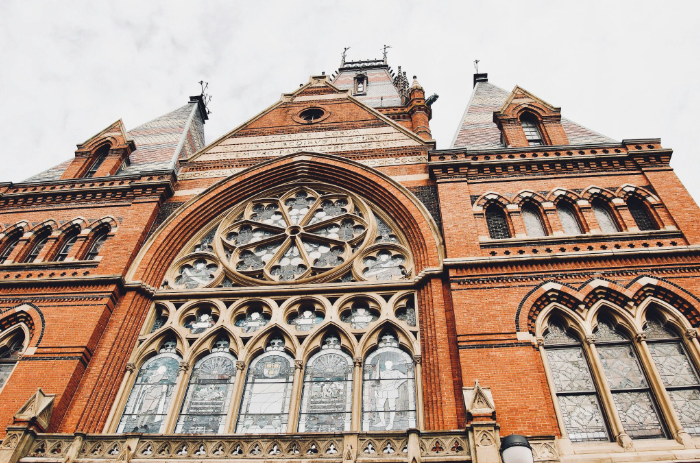
For a generation supposedly tired of old hierarchies, students have become remarkably fluent in a new language of prestige. We claim to distrust elitism, mock networking culture, and roll our eyes at personal branding, yet we are still drawn to the same glittering names. Only now, the obsession is no longer confined to Britain’s familiar institutions. Somewhere between TikTok “day in the life” videos, LinkedIn announcements, and the endless performance of ambition online, the Ivy League has become part of the British student imagination, too.
That shift matters. The Ivy League is not just a collection of American universities; it has become a symbol, a shorthand for brilliance, influence, wealth, and future success. In the same way “Oxbridge” has long operated as a cultural category rather than simply an educational one, Harvard, Yale, and Princeton now appear in British conversations less as academic destinations and more as lifestyle brands. They represent a fantasy of polished achievement: the perfect student with the perfect profile, the perfect extracurriculars, the perfect future.
This is not simply about more students applying abroad. It is about how ambition itself has changed. British students increasingly absorb an Americanised version of achievement, one in which education is not merely about intellectual development but about packaging yourself as exceptional. The appeal of ivy league admissions lies not only in access to a prestigious university but in the promise that the system rewards originality, leadership, and range. Compared with the narrower, more exam-driven image of British university entry, the American model can look more exciting, more holistic, and perhaps even more humane.
But that impression is only half true. The mythology of elite American admissions is built on a contradiction. Applicants are told to stand out, be authentic, and show character, while being assessed in an environment that quietly rewards polish, strategy, and narrative control. Students are encouraged to “follow their passions,” but only in ways that can be legibly transformed into a compelling application story. What appears flexible can be just as performative as the systems it claims to improve upon.
This is where the obsession becomes more troubling than harmless admiration. The more British students internalise this culture, the more they begin to see themselves through its logic. Every activity becomes a potential talking point. Every interest must prove its seriousness. Every achievement needs to fit into an overarching plot about resilience, curiosity, or leadership. Under that pressure, even genuine enthusiasm starts to feel staged. A debate club, a summer school, a volunteering role, a research project: all can become less about learning and more about signalling.
The result is not confidence, but anxiety. Students are pushed to believe that one institution, one brand name, one acceptance letter can validate years of effort and secure a successful future. That belief is seductive because it offers clarity in an increasingly unstable world. When job markets feel uncertain and social mobility feels fragile, prestige seems like protection. The global appeal of elite American universities is, in part, a symptom of wider insecurity. Young people are not foolish for wanting certainty. They are responding to a culture that has taught them to treat status as safety.
Yet the transatlantic prestige race does not simply intensify pressure; it also reshapes fairness. The more complicated and curated the admissions landscape becomes, the more advantage flows to those who understand how to navigate it. At this point, the conversation stops being about aspiration alone and starts being about access. Families with money, time, and institutional knowledge can better decode expectations, refine application strategies, and build long-term plans. That is partly why the growing visibility of college admission consultants should be read as a sign of a deeper problem, not merely a niche service for the overprivileged. Their rise reflects a system that has become difficult to interpret without guidance.
There is, of course, a temptation to romanticise the British alternative. Oxbridge is hardly innocent when it comes to status obsession, nor is the UK free from coaching, insider knowledge, and social advantage. British students have always been aware of educational hierarchies. But the Ivy League fixation adds something new: a distinctly global, highly mediated, and intensely performative model of ambition. It is no longer enough to be clever or hardworking. You must also be interesting in the right way, rounded in the right way, exceptional in the right way, and publicly legible in all of it.
What gets lost in this scramble is the real purpose of higher education. Universities should challenge the way students think, not simply certify that they were impressive at eighteen. They should be places where intellectual risk is possible, where uncertainty is productive, and where failure does not immediately become a threat to one’s entire identity. The tragedy of prestige culture is that it narrows imagination while pretending to expand it. Students begin by chasing possibility and end up trapped inside a script.
The Ivy League has crossed the Atlantic because prestige now travels faster than ever. Through screens, rankings, social media, and aspiration-driven storytelling, elite institutions have become global cultural products. But students should be wary of what they are buying into. Admiration can quickly become imitation, and imitation can become self-erasure. The danger is not that ambitious students dream too big. It is that they inherit a definition of success so rigid, so polished, and so marketable that it leaves little room for a messier, more honest education.
We do not need less ambition. We need a healthier one: one less obsessed with brand names, less seduced by curated excellence, and less willing to confuse prestige with worth.